
Resources
Decoding the "Why": A Professional Guide to the Functions of Behavior
A practical guide for educators, school counselors, support staff, and caregivers

Ms. Safeena Nisthar
26 Oct 2026

Whether standing before a class of twenty-eight diverse learners or managing evening routines at the kitchen counter, every professional and parent eventually confronts moments of acute behavioral disruption. A second-grader shreds their reading assessment; a middle schooler blurts out disruptive jokes during direct instruction; a child collapses onto the hallway floor the moment transition time is announced.
The traditional reaction to these disruptions has long been punitive: deliver a reprimand, assign a detention, revoke a privilege, or issue a timeout. Yet educators and families consistently find that these traditional consequences fail to stop the cycle. The behavior recurs the next morning.
In Applied Behavior Analysis (ABA) and evidence-based positive behavioral support, practitioners take a fundamentally different approach. We look past the disruption and ask an operational question: What is this behavior accomplishing for the individual?
The Core Principle: Behavior is never random, nor is it inherent malice. It is functional communication. When we decode the function driving an action, we replace reactive containment with proactive instruction—equipping learners with practical tools to succeed.
Form vs. Function: The Crucial Clinical Distinction
To evaluate behavior objectively, behavioral science distinguishes between two foundational elements: Topography (what the behavior looks like physically) and Function (the purpose or outcome the behavior achieves).
Focusing strictly on topography is where support plans break down, because identical behaviors can serve completely opposite functions depending on the environment.
Contextual Comparison: The Desk Slam
- General Education Setting:A student slams their desk and tears up their worksheet during independent math drills. The teacher sends the student to the vice principal’s office. The student struggled with the assignment, and while they received a disciplinary mark, the immediate outcome was complete relief from academic demands.
Function: Escape - Home Setting:That same student slams the dinner table and scatters their silverware while both parents are focused on an urgent work call. The parents immediately mute their devices, walk over, and spend fifteen minutes soothing the child.
Function: Attention
Treating the physical act of "slamming" with one identical punishment misses the point entirely. Effective support must match the function, not just what the eyes see.
The Four Universal Functions: The S-E-A-T Framework
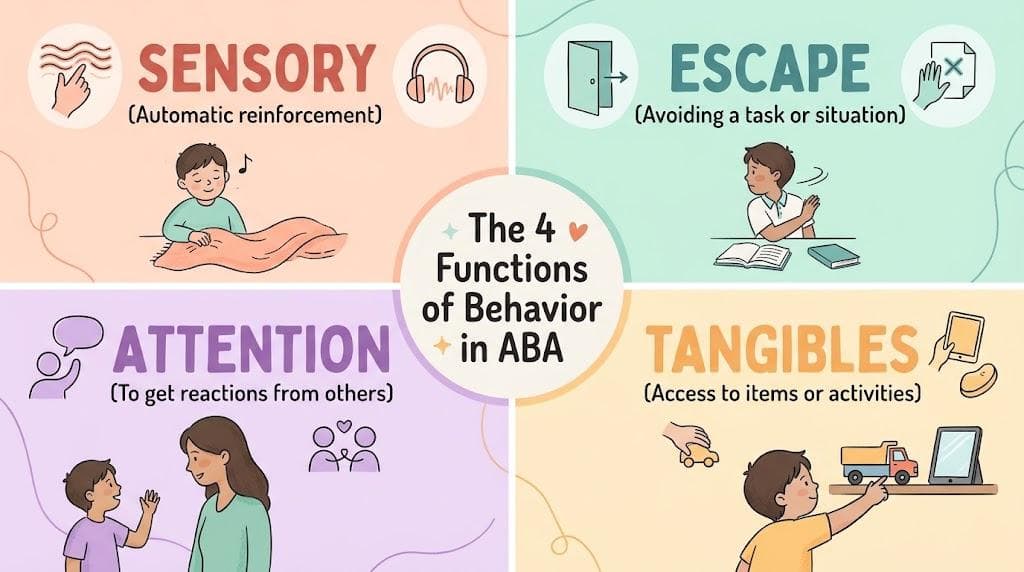
1. Sensory (Automatic Reinforcement)
- Clinical Definition:The behavior creates its own physiological payoff. It happens independently of other people or rewards.
- Classroom Manifestation:Constant pencil-tapping, chewing on shirts or erasers, tipping back on chairs, pacing the perimeter during carpet time, or covering ears during transition bells.
- Home Manifestation:Crashing onto soft couches, pacing hallways, repetitive humming during quiet tasks, or seeking dark, enclosed spaces after community outings.
- Proactive Solutions:Introduce foot resistance bands on classroom chairs, provide discreet chewable sensory tools, schedule proactive movement breaks, and provide low-lit reset areas.
2. Escape and Avoidance (Social Negative Reinforcement)
- Clinical Definition:The behavior terminates, delays, or avoids an overwhelming stimulus, challenging assignment, or uncomfortable environment.
- Classroom Manifestation:Sharpening pencils repeatedly to avoid writing assignments, frequent nurse visits during timed tests, or acting silly so staff removes them from the room.
- Home Manifestation:Battles over morning routines, bolting from the dinner table, or persistent stalling when asked to turn off screens and begin homework.
- Proactive Solutions:Teach self-advocacy using a "2-Minute Break" card, break assignments into bite-sized milestones, and use clear "First/Then" sequences ("First 3 math problems, then 2 minutes of drawing").
3. Attention (Social Positive Reinforcement)
- Clinical Definition:The behavior is maintained by responses, connection, or reactions from adults or peers. Reprimands, sighs, and scolding still register as powerful attention.
- Classroom Manifestation:Blurting out comments without raising hands, creating distractions to trigger classmate laughs, or mishandling materials while watching the teacher's face.
- Home Manifestation:Sudden outbursts the moment a parent answers a work call, teasing siblings in common areas, or engaging in unsafe climbing to pull adults closer.
- Proactive Solutions:Deliver frequent positive attention before behaviors start (scheduled 1-on-1 check-ins), use neutral redirections for minor blurt-outs, and directly teach polite ways to initiate contact.
4. Tangible Access and Environmental Control
- Clinical Definition:The behavior is triggered when a desired item, screen, or routine is denied or removed.
- Classroom Manifestation:Snatching materials out of a peer's hands, refusing to clean up specialized STEM centers, or melting down when another student is designated line leader.
- Home Manifestation:Severe protests when devices are turned off, tantrums at store checkout counters over treats, or intense meltdowns if a routine is unexpectedly altered.
- The "Control & Rigidity" Dynamic:Children often battle intensely over minor routine steps (such as insisting on turning a specific doorknob). This operates as access to predictability—securing a feeling of safety in their day.
- Proactive Solutions:Use visual countdown timers to make transitions predictable, teach structured waiting tolerance, and offer two bounded choices ("Do you want to put your shoes on before or after your coat?").
The Practical Playbook: Moving from Reaction to Real Solutions

From Reaction to Instruction
When an adult focuses solely on eliminating an inconvenient behavior, they are treating a symptom rather than the underlying mechanism. Punitive consequences tell a child what not to do, but they fail to teach what the child should do instead. By identifying whether an action serves Sensory input, Escape, Attention, or Tangible access, educators and families can unite around a shared mission: identifying the missing skill, teaching an empowering alternative, and building an environment where every learner feels understood.